

Now is a precarious time for the cinema. It’s a rote sentiment perhaps, but that’s not necessarily disqualifying. Certainly, the very nature of the modern cinema – always at the intersection between art and commerce, in constant tug-of-war, stretched and yanked and reeled back-and-forth – will always be plagued by the “precarious” moment it currently inhabits. Nonetheless, it’s reasonable to suggest that in no other moment of its history has the cinema been as vulnerable.
You see, we are in the age of the “spectacle,” a term oft-confused and used interchangeably with the cinematic but which poses the unique potential of usurping it altogether. After all, that is its nature – spectacle (unrestrained) swallows all. In today’s world, however, this element of spectacle, in both filmmaking and movie-going, finds itself supercharged by the burgeoning technological innovation and evolution at the door of all mankind, not just the cinematic art form.
Culturally, we’re fixated on how to manufacture it, sustain it and leverage it against increasing economic uncertainty. Audiences are assaulted with artificially generated imagery and bombastic sound (purportedly in the name of the cinematic, though more accurately in the chase of the almighty dollar) not only in the auditoriums whose ever-growing scale promise exponentially enhanced spectacle but even on the small screens that have ingrained themselves on our everyday lives. The tiny screen in the palm of your hand, beckoning your fingertips, commanding your sightline, announcing “Here is spectacle for you. Drink and be merry.” And after being told what it is they need and where to find it and how to get it, the viewer is nurtured into a repeat customer, dependable and dependent. Then it’s a simple matter of rinse and repeat.
Nowhere in the cinematic landscape is the omniscience of the spectacle more evident than that man-made, industry-hardened, financially lucrative ritual known as “summer-blockbuster-season.” But before I risk completely losing the reader and demonizing the industry at large, let me stately rather bluntly – I too live in the same capitalistic society, if money is a dirty word in my vocabulary then I visit it everyday, multiple times a day along with every other dirty word. I don’t fault any industry its quest for financial success, much less one that keeps the lights on in as holy a place as the movie theater. My issue, again, is when “spectacle swallows all.” To quote the piercing words of Marge Gunderson, “There’s more to life than a little bit of money, you know. Don’t you know that?” And so, amidst the onslaught of vicious sight and sound, the exchange of cash for diversion, the rinse and repeat, one of the most cinematic experiences of the year fell through the cracks.
Filmmaker Victor Kossakovsky’s latest documentary “Architecton” presents yet another exquisite entry into his formally penetrating exploration of the quiet, overlooked world living parallel to humanity, hidden by our own everyday self-interest and survival. In much the same way he treated the subject of water in “Aquarela,” Kossakovsky now turns his camera toward the land, unearthing not only mysteries of the rock we inhabit but also inadequacies in how we as mankind elect to inhabit it.
Opening with a quote from Italian poet Giovanni Pascoli – “There is something new within the sun today, or rather ancient” – it’s clear that Kossakovksy, as evidenced by his previous work, is a great admirer for those ancient, proto-human elements that constitute our very world. For Kossakovsky, rock, like water before it, is humanity’s ancestor, worthy not only of adulation and celebration, but more importantly reflection, study and understanding. Yet, in its reference to the “new,” it feels as though the filmmaker is taking a more assertive stance against some opaque, yet pervasive human violation against a natural order. This fault line between the ancient and the new will be constantly examined and juxtaposed throughout the film – illustrating its harmony in the natural mystery and ubiquity of geologic space as well as its extreme divergence in the paradoxical manner in which man has engaged with it.

This opposition is most clearly depicted in Kossakovsky’s rendering of the remnants of contemporary concrete buildings from all over the world facing destruction from disasters both natural and man-made – these wide vistas largely captured with aerial drone photography which creates a certain alienating distance and passivity among viewers. These are sights of widespread devastation we would rather look away from, much less take responsibility for. Compare these remnants to the temple ruins of Baalbek, and Kossakovsky is not only painting a picture of inevitable societal collapse but more significantly what endures from each passing societal iteration, what legacy is left behind after each human mark. Often, the film will amplify this temporal distance by presenting the ancient relics of the past in stark, often solemn black and white cinematography.
Like the documentarians Godfrey Reggio and Ron Fricke before him, and alongside his anthropologist contemporaries Lucien Castaing-Taylor, Verena Paravel, Stephanie Spray and Pacho Velez, Kossakovsky fuses the bare essentials of cinema (image, sound, montage) to construct a visceral experience for the viewer. The result, however hypnotizing for the audience, nonetheless stands apart from “spectacle” in that it seeks to awaken viewers to probe and reflect and question rather than passively watch. Certainly, “Architecton,” like the work of all these filmmakers, is a cinema of the senses, but only in so much as these artists are attempting to give a face and voice to a part of life that is otherwise invisible to immediate, everyday human perception. What is perhaps the most emotionally overwhelming quality of the films from these artists, indeed in their very approach to filmmaking, is that in rigorously breaking down the essence of their subject with the instruments of cinema they too manage to express something vital and essential about cinema itself.
With its low, brassy echoes (courtesy of the masterful Russian-French composer, Evgueni Galperine) and its piercing magnifying lens studying every pore, every crack of rock as though wrinkles on an ancient face, Kossakovsky’s “Architecton” sculpts a raw personification of our ancestor. It is nature anthropomorphized – mysterious, generous, neglected, and even exploited. Swaying back and forth between imagery of the element’s microscopic breath and its trifling putty in the palm of man, the film builds a visual collage that goes beyond scientific observation into metaphysical poetry, a meditation on all things past and always, vast and finite. Ancient and new.
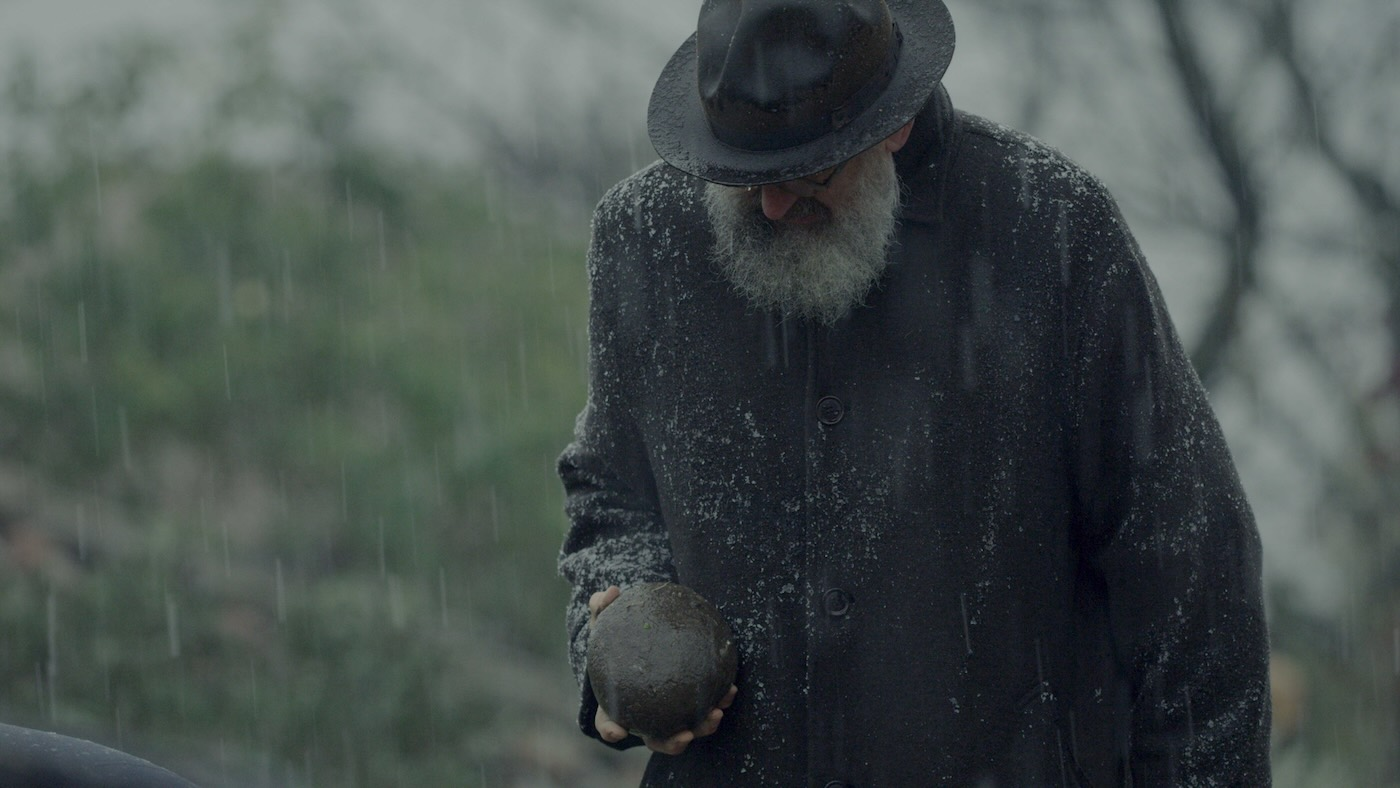
It’s striking, moreover, to consider a telling divergence here from the filmmaker. Kossakovsky’s work has always allowed for the peripheral participation of mankind, often a passive participant. Ironically, they could be overlooked as an incidental presence in the films’ larger creative scope – a humorous subversion I’m sure pleases the filmmaker. Nonetheless, he has always struck a delicate balance, not forfeiting his gaze from a nature that is often unspoken for, but also not completely divorcing it from man. “Architecton” feels like a shift for the filmmaker in this regard. Certainly the hardness of human behavior and its consequences are painted in panoramic vistas, but so too is the delicate, fragile existence of Italian architect Michele de Lucchi designing a stone-circle of life in the cold and dreary winter. Amidst his garden, it’s absolutely nothing grand at all – a simple patch of fecund mindfulness, really. And yet, it is completely out of the ordinary and out of step with civilization today. Finally, during the film’s epilogue, we’ll see yet another uncharacteristic human face, that of the filmmaker who has breached his own line and become the subject of his film, as he addresses Michele. But there’s no real vanity on display, quite the opposite. We now see the filmmaker’s own frustration, incomprehension and pleas as he seeks counsel from a human being you can sense he admires, yet cannot offer much solace outside of mutual sentiment. It’s a poignant and unnerving moment for the viewer, who understands that the filmmaker has broken his illusion because as breathtakingly beautiful and purely cinematic as it is, it is nonetheless insufficient in addressing the urgency of our current existence.