
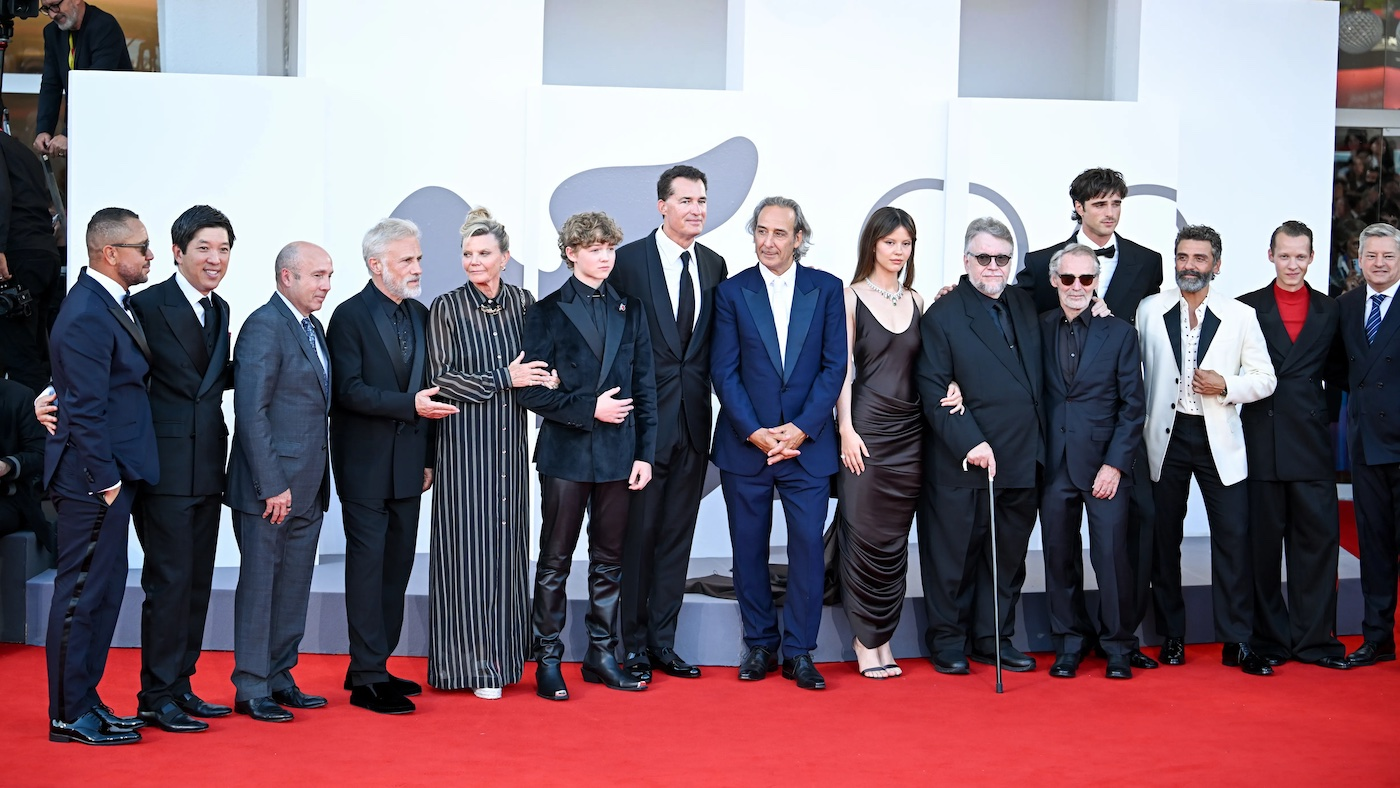

Guillermo del Toro’s dream project was finally unveiled tonight at the Venice Film Festival. What seems like a perfect melding of artist and subject, his take on Frankenstein certainly drew it’s ardent admirers—many who were in awe of the film’s craftsmanship, and del Toro’s success in crafting a transcendent, romantic, emotionally complex melodrama—as well as some more apprehensive spectators—those who found that the film’s spectacle overwhelms intimacy and emotional engagement, and that it lacks the spark of del Toro’s previous enchantments like Pan’s Labyrinth.
The Guardian praised it as “monstrously beautiful,” noting that the shift toward the creature’s perspective lends the story a “sanctified, almost romantic tone.” Reuters observed that the film sheds horror in favor of humanity, leaning instead into poetic storytelling. The Hollywood Reporter called Frankenstein “not so much straight-up horror as tragedy, romance, and a philosophical reflection on what it means to be human… epic-scale storytelling of uncommon beauty.”
While Oscar Isaac’s portrayal has been described by some as somewhat caricature-esque, Jacob Elordi’s monster is drawing stronger notices. Critics note he plays the creature as a James Dean–like outsider—sympathetic, handsome, and radiating genuine warmth and depth. Vulture even calls him “the part that holds the movie’s soul.” The Times, however, dismissed his performance as “uninspiring and lacking menace,” likening him more to a “glamorous gymnast” than a tortured creation.
Detractors like The Independent and Variety described the film as all style, little substance—oppressive, indulgent, and collapsing under the weight of del Toro’s vision into a muddled collage of tones. Others have criticized the script as overstuffed, uneven, and emotionally dull. Currently, the film holds a 73 on Metacritic: respectable, though certainly short of the sky-high expectations.

So what to make of Frankenstein’s Oscar chances? The film is clearly positioned to earn recognition in the technical categories—Production Design, Costume, Makeup/Hairstyling (a branch that has shockingly snubbed del Toro before), and possibly Cinematography. Del Toro is no stranger to these fields. But can Frankenstein push beyond them? A Golden Lion win could certainly boost its prospects (reports suggest it earned a 10-minute standing ovation at the premiere). Without that, though, it’s hard to see the Academy giving del Toro another Nightmare Alley-style acknowledgment: technical nods, Best Picture, and nothing else. They did that already; why do it again? Could Elordi sneak into the Globes or SAG? Possible, but far from guaranteed. At this point, Frankenstein looks most likely to be celebrated for its lavish visual achievement more than anything else.
Only a handful of people have seen Jim Jarmusch’s latest, Father Mother Sister Brother, and so far—judging mostly from early Letterboxd reactions—it’s getting mixed-to-good reviews from fans. It appears to be, as one user, Dust Magazine, put it: slow, airy work with flashes of humour and tenderness — though unlikely to linger as one of his most memorable.” We’ll know more tomorrow.

The other big premier (and one highly anticipated by us here at Frames and Flicker) was Kent Jones’s next feature Late Fame, written by Oscar nominee Samy Burch (2023’s May December). We met Kent Jones when he was the director of the New York Film Festival, and besides being a brilliant film programmer, he’s also an extremely talented director. His beautiful character study Diane was one of our favorite films of 2019, and we’ve been eagerly anticipating his next film.
We’re very happy to see that his latest is being met warmly by critics. The Guardian calls it “a compelling slice-of-life fable” set in contemporary Manhattan, praising Willem Dafoe’s natural, honest performance and the film’s articulation of creative hunger amid posturing admirers. The Hollywood Reporter describes it as “a satire of artistic pretensions and a tantalizing character study,” noting its satisfying depth and “exquisite grace notes.” IndieWire credits Jones’s direction with lending even the simplest scenes “breezy maturity and palpable longing,” while Screen International highlights Samy Burch’s screenplay for its complex female characters, with Greta Lee “stealing the film whenever she’s on screen.” It may not be an Oscar play, but we can’t wait for this one.